
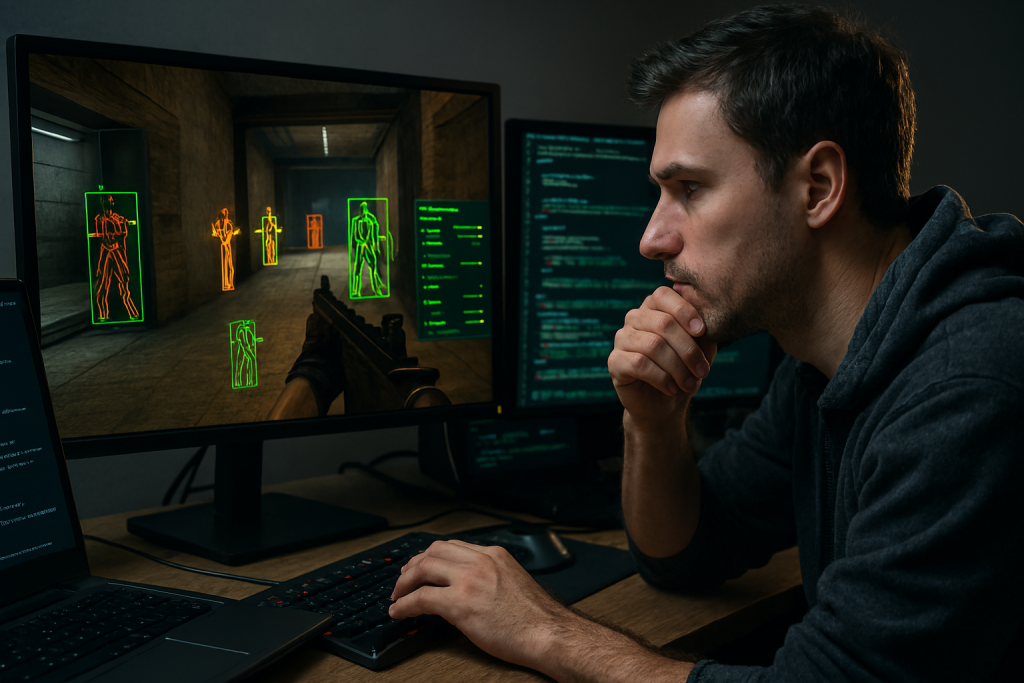
Developing aimbots and wallhacks involves finding the game’s code to understand how it works under the hood. This process allows cheat inventors to identify explicit memory addresses that influence the game.
If you want to write software that detects and prevents cheats from being used. This will safeguard your game’s integrity and ensure a fair experience for all players.
Understanding these two cheats matters. It will help you secure your programming languages and tools, such as disassemblers and debuggers. Here we’ll be looking at how they are made.
Aimbot Vs Wallhacks
Aimbots and wallhacks are two of the most predominant cheats used in online gaming, especially in first-person shooter (FPS) games. These cheats provide a one-sided benefit to players, sabotaging the integrity of the game and frustrating other people’s experience. Aimbots are the magical helpers that do the targeting for you, while Wallhacks are like the X-ray vision of the game.
How Does the Game Memory Work?
Before creating aimbots and wallhacks, cheat developers must understand how memory works. Game memory is the data stored in a computer’s RAM during a gaming operation. This data includes relevant details, like the player’s position and information about the game’s state.
Cheat developers use different kinds of strategies to control and access this memory, allowing them to modify the game’s behavior as they want.
Techniques Used in Detecting and Mitigating Wallhacks and Aimbots
Game developers use various techniques to detect and mitigate aimbots and wallhacks, including the following:
- Signature Scanning: As a game developer, you may use signature scanning to point out known cheat signatures and ban the players who are using them.
- Behavior Analysis: Being a game creator allows you to investigate a player’s behavior to detect irregularities in the game that may imply cheating.
- Memory Protection: You can also use memory preservation techniques, such as obfuscation and encryption, to make it hard for cheating developers to access and control the game’s memory.
While there are several techniques that can be used to detect wallhacks and aimbots, players can still get cheats from a few reliable sources. Websites like PlayWithCheats has many hacks that can go undetected in games despite any technique used by game developers.
How Aimbots Are Developed
Aimbots are typically created by recognizing the memory addresses that store data about enemy player positions. Here is a step-by-step overview of the process:
Reverse Engineering
Cheat developers use tools like disassemblers and debuggers to practically “spy” on the game’s code. They do this because they are trying to point out the specific functions that address things like aiming and player positions. In other words, they want to crack open the game’s engine to see the inner workings and then use their discovery to create cheats like aimbots or wallhacks.
Memory Address Identification
After a cheat developer identifies the game’s functions, the cheat dev identifies the actual memory addresses where the game stores enemy player positions. They look for specific instructions or patterns through the game’s assembly code, for patterns or specific instructions that reveal where data is stored. Whether it’s for aimbots or wallhacks, having that information is key to developing the cheat.
Aimbot Logic
With the memory addresses in hand, cheat devs can now write the aimbot logic. This is typically the brain of this procedure. It takes over enemy positions and calculates the perfect aim, making it extremely easy for players to hit the target.
Hooking
The aimbot logic is injected into the game’s code through hooking, allowing it to tap into the aiming algorithms. The aimbot becomes a component of the game, silently controlling the aiming process.
How Wallhacks Are Made
Wallhacks manipulate the game’s rendering engine to bring out enemies or entities through the walls. Here’s a step-by-step overview of the process:
Reverse Engineering
Wallhacks let you see enemies or objects through walls by manipulating the game’s graphics. This gives you an unfair advantage. So, as a cheat developer, you can use disassemblers and debuggers to interpret the game’s rendering engine and single out the functions that are responsible for drawing these enemies and objects.
Depth Buffer Manipulation
Depth Buffer Manipulation is a common technique used in making wallhacks. The buffer virtually helps the game to single out what objects to draw in front of others. Cheat developers use this buffer to make enemies visible through walls. They can either turn off the depth test or rewrite its values to help them see through solid objects.
Shader Manipulation
Shader manipulation is another way wallhacks are made. Shaders are like little programs that tell the GPU how to draw things on screen. So, they are tweaked; both the shaders and cheat devs can alter how objects are rendered, like making them visible through walls. It’s like rewriting the game’s visual rules for more advantage.
Hooking
When developers create the wallhack logic, they integrate it into the game’s code. This is done through hooking, where the wallhack modifies and intercepts the game’s rendering analyses. It is more like inserting a custom script into the game’s engine. This allows the wallhack to alter the visuals and make enemies visible through the walls.
Conclusion
Both aimbot and wallhack cheats are sophisticated tools that manipulate game engines through techniques like memory address, shader manipulation, and code injection. If you understand how these cheats are made, it can help you better, when safeguarding your games and it will definitely provide a fair experience for everyone playing.